
"Burundi export markets"
300 article(s) found

Brief introduction of Burundian coffee and producing areas. How about Burundian coffee?
Following Ka Pai (Wechat official account vdailycom) found that Beautiful Cafe opened a small shop of its own in Burundi, the heart of Africa. According to the statistics of the World Bank in 2011, about 600000-800000 families in Burundi depend on coffee for a living, and coffee is the core of Burundi. East Africa has always been a high-quality coffee civilization, and Burundi is no exception.

Introduction of boutique coffee with characteristics of varieties, flavor and taste in Burundian coffee producing area
There are two major ethnic groups in Burundi, and only about 15 percent of the Tutsi have ruled the country since the 16th century, controlling the civilian population, which is mainly made up of Hutu, plus a very small number of indigenous Twa. This abnormal social structure in which ethnic minorities occupy a high position has buried the evil seed of national instability, and in 1

Burundian Coffee with excellent acidity description of Burundian Coffee Flavor characteristics of Fine Coffee
There are many plateaus and mountains in Burundi, most of which are made up of the plateau on the east side of the East African Rift Valley. The national average elevation is 1600 meters, which is known as the mountain country. According to the topography of Burundi, it can be divided into three regions: the western plain, along the Ruzizi River, the Rift Albrtine plain, 774 to 1000 meters above sea level; and the central and western mountains, with an average elevation of 1700 meters, with the highest peak in Bujumbura.

Burundian Coffee, a rich and soft coffee from the war-torn area
Coffee workshop (Wechat official account cafe_style) Burundi, as the heart of Africa, is a small landlocked country located at the junction of eastern and central Africa, across the Nile and Congo basins, with mainly hilly and mountainous landforms, with excellent coffee-growing altitude. Burundi is located in central Africa with a pleasant climate.

Burundian coffee with excellent acidity describes the characteristics of grinding degree and introduces the taste of varieties in producing areas.
There are two major ethnic groups in Burundi, and only about 15 percent of the Tutsi have ruled the country since the 16th century, controlling the civilian population, which is mainly made up of Hutu, plus a very small number of indigenous Twa. This abnormal social structure in which ethnic minorities occupy a high position has buried the evil seed of national instability, and in 1

Burundian Coffee with excellent acidity Flavor description of Burundian Coffee characteristics of Fine Coffee beans
10.5 million (2014). It consists of three tribes: Hutu (84%), Tutsi (15%) and Tewa (1%). The official languages are Kirundy and French, Mandarin is Kirundy, and some residents speak Swahili. Among the residents, 61% believe in Catholicism, 24% believe in Protestantism, 3.2% believe in primitive religions, and the rest believe in other religions or do not. The proportion of the population is: male accounts for the total

A brief introduction to the flavor and aroma characteristics of Burundian coffee with fruit flavor
Londi Coffee bears a striking resemblance to neighboring Rwanda, where coffee from the two countries is often confused. Burundian coffee is mainly grown in bourbon, with traditional wet processing of coffee cherries. Its boutique coffee is characterized by elegant sweetness and bright citrus aromas. Burundi is a small landlocked country located on the border between eastern and central Africa.

Introduction to the description of the characteristics and flavor of Burundian coffee varieties in the growing environment
Burundi coffee was introduced by Belgian colonists in 1930. Unfortunately, many of these farms are on the border with war-torn Rwanda, putting pressure on coffee production. Coffee production in Burundi: Burundian coffee is now grown only on small farms. Almost all the coffee produced in Burundi is Arabian coffee beans.

Where does Africa produce the best coffee? six African countries that grow high-quality coffee
African coffee is one of the best coffee in the world. Although famous for its fruity and wine acidity, each country offers unique assets due to differences in production, processing and climate. Coffee is grown in many African countries, especially in East Africa. But only a few countries export high-quality Arabica coffee beans to western markets. There are six African coffee producing areas that you should know about.

Introduction to the varieties of Burundian Coffee Manor with lemon, orange and almond aroma
Burundian coffee bears a striking resemblance to neighboring Rwanda, where coffee from the two countries is often confused. Burundian coffee is mainly grown in bourbon, with traditional wet processing of coffee cherries. Its boutique coffee is characterized by elegant sweetness and bright citrus aromas. This batch belongs to bourbon species micro batch. [Bulundi Champion processing Factory] is located in the card.

Burundian Coffee Flavor description characteristics of Grinding degree introduction of High-quality Coffee beans in producing areas
There are two major ethnic groups in Burundi, and only about 15 percent of the Tutsi have ruled the country since the 16th century, controlling the civilian population, which is mainly made up of Hutu, plus a very small number of indigenous Twa. This abnormal social structure in which ethnic minorities occupy a high position has buried the evil seed of national instability, and in 1

Citrus-flavored and sweet Coffee Variety of Coffee Variety in Kimmel Manor, Rwanda
Rwanda is located in the south of the equator in east-central Africa, a landlocked country. It is bordered by Tanzania to the east, Burundi to the south, Zaire to the west and northwest, and Uganda to the north, with a land area of 26338 square kilometers, ranking 149th among all countries in the world and close to Burundi, Macedonia, Haiti and Albania. Rwanda is located in east-central Africa, bordered by the Democratic Republic of the Congo in the west and north.

How do you drink Burundian coffee? Burundian Coffee Bean Flavor Price list Story
For more information on coffee beans, please follow the coffee workshop (Wechat official account cafe_style) Burundian coffee beans. Belgian colonists brought coffee to Burundi in 1920. As a result of the policy imposed by the Belgian colonists, by 1933, each farmer was required to plant at least 50 coffee trees. Burundi is located in East Africa.

Mellow Burundian Coffee Flavor Taste introduction to Fine Coffee in Manor production area
There are many plateaus and mountains in Burundi, most of which are made up of the plateau on the east side of the East African Rift Valley. The national average elevation is 1600 meters, which is known as the mountain country. According to the topography of Burundi, it can be divided into three regions: the western plain, along the Ruzizi River, the Rift Albrtine plain, 774 to 1000 meters above sea level; and the central and western mountains, with an average elevation of 1700 meters, with the highest peak in Bujumbura.

Burundian Jackson bourbon variety coffee beans introduction to boutique coffee beans
The cultivation of Arabica coffee trees in Cameroon (Cameroon) began in 1913 as the Blue Mountain Coffee from Jamaica, but the country also produces large quantities of Robbins coffee. The quality and characteristics of Cameroon coffee is similar to that of coffee from South America. The best coffee in the country comes from Bamileke and Bamoun in the northwest. Here, it also grows some giant coffees.

Introduction to the quality characteristics of Burundian coffee beans by describing the characteristics and flavor
Burundian boutique coffee beans introduce many highlands and mountains in Burundi, most of which are composed of the plateau on the east side of the East African Rift Valley, with a national average elevation of 1600 meters, known as a mountain country. According to the topography of Burundi, it can be divided into three regions: the western plain, along the Ruzizi River, the Rift Albrtine plain, 774 to 1000 meters above sea level, and the central and western mountains, with an average elevation of 1700 meters.

A brief introduction to the cultivation of fine coffee beans in Burundi with mellow taste, geographical location, climate and altitude
There are many variables that affect the quality of the final beans. For example, each mountain has a different microclimate, which in turn affects the growth, picking and handling of coffee fruits, and varies from day to day. Nathan James Johnston, the boss of Cartel Coffee Roasters in Australia, said: working with Long Miles, we can make it clear
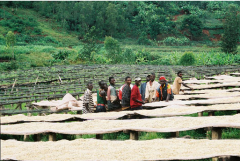
Starbucks Burundian Coffee Burundian Coffee producing area introduces where Burundian coffee beans come from?
For professional baristas, please follow the coffee workshop (official Wechat account cafe_style) Burundi is located on the south side of the equator in east-central Africa. It is bordered by Rwanda to the north, Tanzania to the east and south, Congo (Kinshasa) to the west, and Lake Tanganyika to the southwest. There are many plateaus and mountains in the territory, most of which are made up of the plateau on the east side of the East African Rift Valley. The average elevation of the whole country is 1600 meters, which is called the mountain country.

Burundian coffee grows in war-torn areas but has fragrant, soft-tasting coffee.
Professional coffee knowledge exchange more coffee bean information please follow the coffee workshop (Wechat official account cafe_style) Burundi from the war-torn areas of aromatic, soft-tasting coffee. Burundi has the most diverse and successful coffee industry in the world, and has its own characteristics. Coffee in this country was introduced by Belgian colonists in 1930 and is now available only in

Burundian Coffee Flavor and taste introduction to the characteristic varieties of high-quality coffee beans in the manor area
There are two major ethnic groups in Burundi, and only about 15 percent of the Tutsi have ruled the country since the 16th century, controlling the civilian population, which is mainly made up of Hutu, plus a very small number of indigenous Twa. This abnormal social structure in which ethnic minorities occupy a high position has buried the evil seed of national instability, and in 1